
 Log in
 Start Free Trial
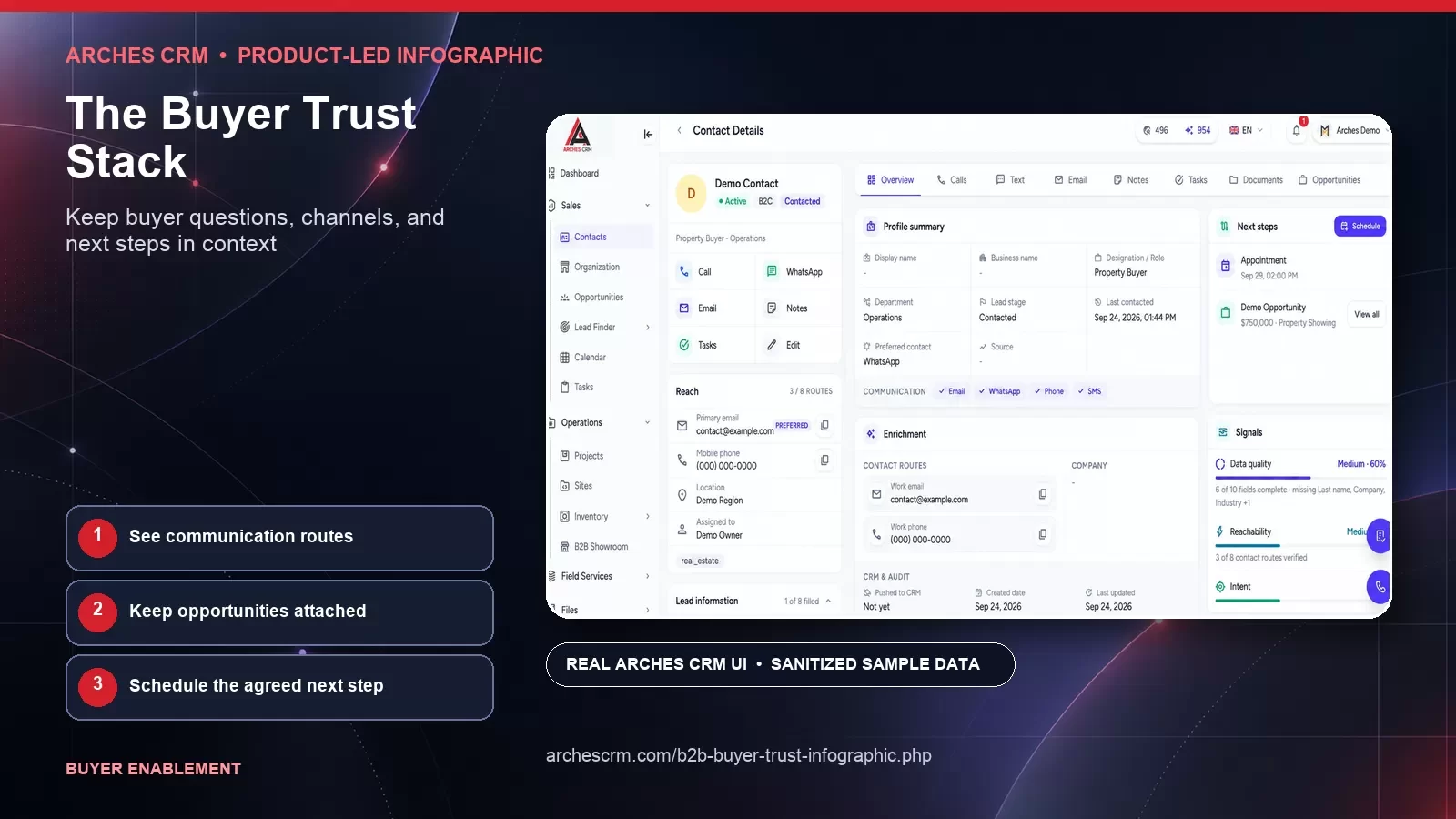
Keep buyer questions, channels, and next steps in context
Keep trust signals visible beside the next conversation. These authentic Arches CRM application views use sanitized synthetic sample data and are specific to this workflow — not a repeated generic screenshot set.


See communication routes
Keep opportunities attached
Schedule the agreed next step
Why this framework matters
Trust is not a tone of voice or a badge collection. Buyers evaluate whether a claim is specific, attributable, current, relevant to their context, and honest about limitations. Content earns confidence when it helps someone make a decision even if that decision is to pause or choose another path.
Unsupported superlatives may attract a click but create friction in serious evaluation. If sales material changes its promise between pages, hides assumptions, or makes proof difficult to inspect, the buyer must spend extra effort validating the seller. A shared evidence stack reduces that burden and gives teams a standard for reviewing claims before publication.
The trust stack answers the buyer's practical evaluation questions
Swipe or scroll to view the full diagram.
Read the infographic transcript
- Problem clarity: State the problem, intended audience, scope, and conditions precisely. Replace universal promises with language the buyer can compare with their situation.
- Understandable process: Explain how the approach works, what the buyer and vendor each provide, and where important decisions or dependencies occur.
- Real, attributable proof: Connect evidence to a named, reviewable source. Distinguish customer-approved examples, independent research, first-party observation, and assumption.
- Implementation reality: Show owners, setup work, training, change, and time dependencies honestly. A feature list should not stand in for an adoption plan.
- Risk and limits: Identify constraints, no-fit conditions, and what the evidence does not establish. Give the buyer room to investigate without a hidden escalation.
- Transparent pricing context: Explain what shapes cost, scope, and change. Avoid false precision when the buyer's requirements have not been established.
- Security evidence: Provide current security, privacy, access, and governance evidence appropriate to the solution. Route unanswered questions to an accountable reviewer.
Work through the framework
Problem clarity
State the problem, intended audience, scope, and conditions precisely. Replace universal promises with language the buyer can compare with their situation.
Understandable process
Explain how the approach works, what the buyer and vendor each provide, and where important decisions or dependencies occur.
Real, attributable proof
Connect evidence to a named, reviewable source. Distinguish customer-approved examples, independent research, first-party observation, and assumption.
Implementation reality
Show owners, setup work, training, change, and time dependencies honestly. A feature list should not stand in for an adoption plan.
Risk and limits
Identify constraints, no-fit conditions, and what the evidence does not establish. Give the buyer room to investigate without a hidden escalation.
Transparent pricing context
Explain what shapes cost, scope, and change. Avoid false precision when the buyer's requirements have not been established.
Security evidence
Provide current security, privacy, access, and governance evidence appropriate to the solution. Route unanswered questions to an accountable reviewer.
How to apply it
Audit one high-traffic page and one frequently used sales document. Highlight every measurable promise, comparison, superlative, testimonial, and implied guarantee. For each, record its source, scope, date, owner, and limitation; revise or remove anything that cannot survive inspection.
Build claim review into the content workflow rather than treating it as a legal checkpoint at the end. Give sales a short approved explanation of each important proof point so the website and conversation stay aligned. Capture buyer questions to reveal where clarity is still missing.
What to review in your own process
Use first-party evidence from your own workflow. Define each measure before collection, preserve unknowns, and review quality with the teams responsible for the handoff.
- Material claims with a current owner, source, and review date
- Buyer questions resolved without changing the original promise
- Conflicting product or outcome language found and corrected
- Claims retired when their evidence or scope no longer applies
Common questions
What makes B2B content trustworthy?
Trustworthy content uses precise language, shows where evidence comes from, describes relevant conditions, acknowledges limits, and remains consistent with the actual buying and customer experience.
Are customer testimonials enough to prove a claim?
A testimonial can illustrate one customer's experience when permission and context are clear. It does not automatically establish a typical result or guarantee. Keep the customer's words accurate and explain the scope without adding unsupported conclusions.
How often should marketing claims be reviewed?
Set a cadence based on how quickly the product, evidence, regulation, and market can change. Also trigger review after material product updates, new research, customer corrections, or a change in the intended audience.
Primary references and review record
Editorial framework: This is an Arches CRM editorial framework. Its citations support related implementation, regulatory, measurement, privacy, accessibility, provider, or claim guidance; they do not independently validate the framework or prove a particular result.
- Federal Trade Commission: Advertising FAQs: A Guide for Small Business (accessed 2026-09-27)
- Federal Trade Commission: Endorsements, Influencers, and Reviews (accessed 2026-09-27)
Author: Arches CRM Editorial Team · Reviewer: Arches CRM Revenue Operations Review · Last reviewed: 2026-09-27
Continue exploring
Related Arches CRM whitepapers
Put the framework into a real CRM workflow
Use your own records, definitions, and review process to evaluate whether Arches CRM fits the way your team works.
Start your 7-day trial