
 Log in
 Start Free Trial
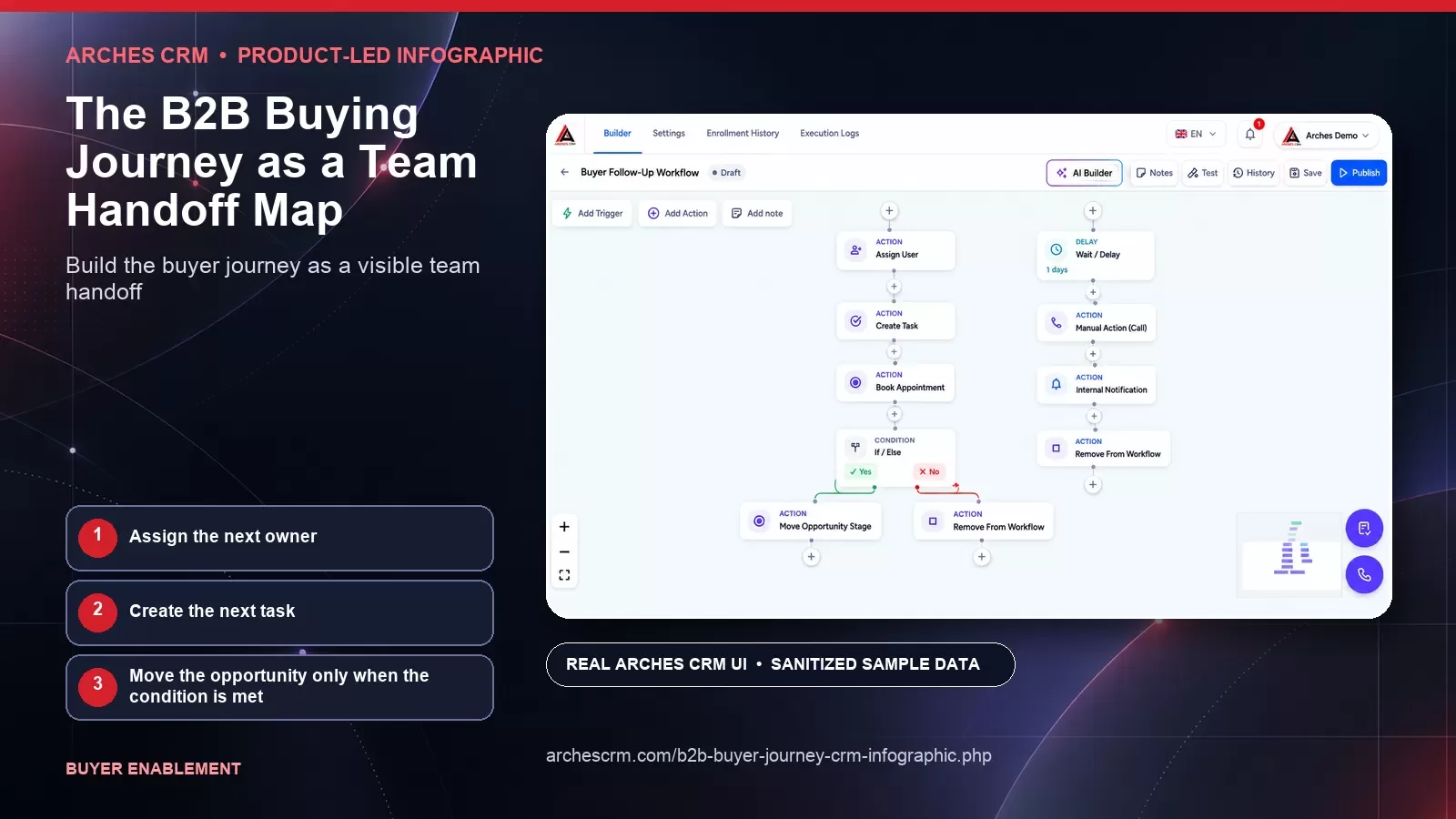
Build the buyer journey as a visible team handoff
Map journey handoffs into owned follow-up automation. These authentic Arches CRM application views use sanitized synthetic sample data and are specific to this workflow — not a repeated generic screenshot set.


Assign the next owner
Create the next task
Move the opportunity only when the condition is met
Why this framework matters
Technology purchases rarely move through a single linear buyer journey. Different participants enter when risk, integration, security, procurement, or operational change becomes relevant. Useful buyer enablement makes those questions easier to resolve without pretending every participant shares the same priorities.
A journey built around seller stages can miss the buyer's real work. When technical validation, policy review, and adoption planning surface late, deals stall or restart. Mapping decisions and evidence—rather than only marketing touches—helps teams prepare content and conversations for the committee's unresolved questions.
Buyer questions move through a shared team handoff map
Swipe or scroll to view the full diagram.
Read the infographic transcript
- Stage criteria: Define entry and exit from buyer evidence rather than seller activity. Make uncertainty visible when the criteria are not yet satisfied.
- Accountable owner: Assign the team member responsible for coordinating the current decision and returning complete context at the next handoff.
- Buyer question: Name the question the buying group is resolving now, including business, technical, security, procurement, or implementation concerns.
- Required evidence: Connect content, validation, and conversations to the exact question. Identify what remains assumed and which reviewer must inspect it.
- Mutual next action: Use a step accepted by the buyer and seller, with owners and a realistic time window. An internal task alone does not prove movement.
- Nurture path: When the question is real but timing is early, provide useful information at an agreed cadence without pretending the evaluation is active.
- Recycle with reason: Return or close work when fit, priority, evidence, or timing no longer supports the stage. Preserve the reason so future engagement begins honestly.
Work through the framework
Stage criteria
Define entry and exit from buyer evidence rather than seller activity. Make uncertainty visible when the criteria are not yet satisfied.
Accountable owner
Assign the team member responsible for coordinating the current decision and returning complete context at the next handoff.
Buyer question
Name the question the buying group is resolving now, including business, technical, security, procurement, or implementation concerns.
Required evidence
Connect content, validation, and conversations to the exact question. Identify what remains assumed and which reviewer must inspect it.
Mutual next action
Use a step accepted by the buyer and seller, with owners and a realistic time window. An internal task alone does not prove movement.
Nurture path
When the question is real but timing is early, provide useful information at an agreed cadence without pretending the evaluation is active.
Recycle with reason
Return or close work when fit, priority, evidence, or timing no longer supports the stage. Preserve the reason so future engagement begins honestly.
How to apply it
Interview recent buyers, no-decision accounts, sales, solutions, implementation, and security stakeholders. Ask what decision each participant had to make, which evidence reduced uncertainty, and where information arrived too late. Convert repeated questions into a shared map.
In the CRM, track participants and open questions in a way that supports the team without creating fictional certainty. A missing security reviewer or implementation owner should remain an explicit gap. Link content to the question it resolves, then review whether it helped the buyer advance.
Make cross-functional handoffs explicit across marketing, sales, technical review, security, procurement, legal, and implementation. For each unresolved decision, name the reviewer, evidence needed, accountable owner, and next accepted action instead of assuming a linear buyer journey.
What to review in your own process
Use first-party evidence from your own workflow. Define each measure before collection, preserve unknowns, and review quality with the teams responsible for the handoff.
- Open committee questions with a named owner and next action
- Required reviewers identified before their decision becomes urgent
- Buyer-provided evidence supporting timing and value assumptions
- No-decision and loss reasons captured at the decision level
Common questions
Who participates in an IT buying committee?
Participation depends on the purchase. Common perspectives include the business owner, technical evaluator, security or privacy reviewer, finance or procurement, legal, implementation, and end users. Map the real participants rather than forcing every deal into one roster.
Is the IT buyer journey linear?
Usually not. Reviews may overlap, repeat, or introduce new requirements. Treat the map as connected decision zones and update it when evidence changes instead of assuming every account follows a fixed sequence.
What content helps technology buyers?
Useful content answers a specific decision question with clear scope, evidence, assumptions, and limitations. Examples can include implementation plans, security documentation, workflow explanations, evaluation guides, and buyer-defined business-case inputs.
Primary references and review record
Editorial framework: This is an Arches CRM editorial framework. Its citations support related implementation, regulatory, measurement, privacy, accessibility, provider, or claim guidance; they do not independently validate the framework or prove a particular result.
- Google Search Central: Creating helpful, reliable, people-first content (accessed 2026-09-27)
- National Institute of Standards and Technology: NIST Privacy Framework (accessed 2026-09-27)
Author: Arches CRM Editorial Team · Reviewer: Arches CRM Revenue Operations Review · Last reviewed: 2026-09-27
Continue exploring
Related Arches CRM whitepapers
Put the framework into a real CRM workflow
Use your own records, definitions, and review process to evaluate whether Arches CRM fits the way your team works.
Start your 7-day trial