
 Log in
 Start Free Trial
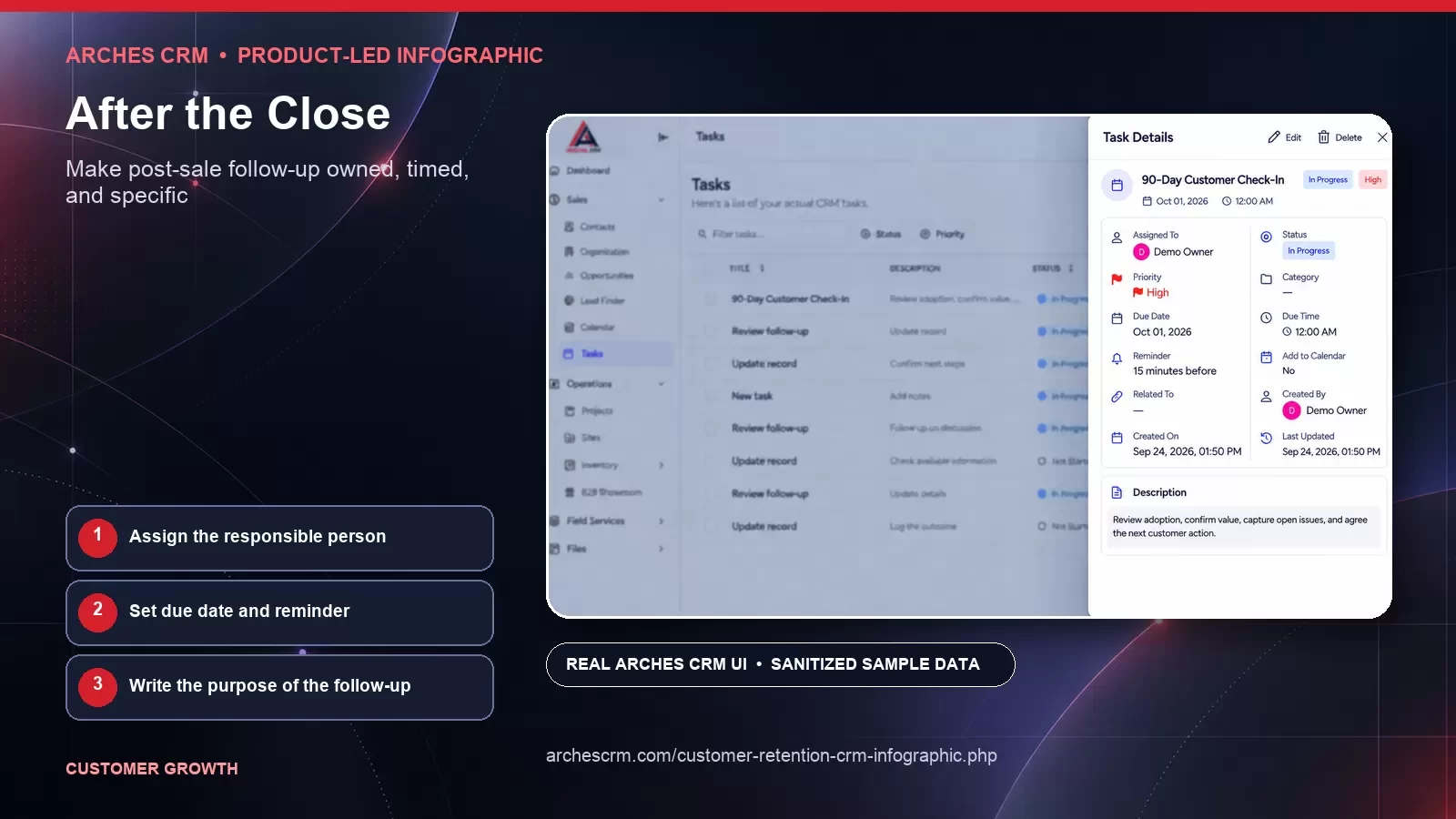
Make post-sale follow-up owned, timed, and specific
Protect retention with owned tasks on existing accounts. These authentic Arches CRM application views use sanitized synthetic sample data and are specific to this workflow — not a repeated generic screenshot set.


Assign the responsible person
Set due date and reminder
Write the purpose of the follow-up
Why this framework matters
Repeat business begins with the promise made during the first sale. If expectations, ownership, and the first useful outcome are unclear, the account enters renewal work with unresolved risk. A value loop connects the commercial record to adoption, issues, outcomes, and the customer's changing priorities.
Teams often discover dissatisfaction only when a renewal date or expansion target arrives. By then, the customer may have accumulated unaddressed friction. A shared loop makes early signals visible, creates accountable recovery, and prevents irrelevant upsell activity from replacing genuine customer progress.
Customer growth follows delivered value, honest reviews, and relevant asks
Swipe or scroll to view the full diagram.
Read the infographic transcript
- Delivery handoff: Translate the sale into scope, responsibilities, constraints, success evidence, and the first useful outcome. Preserve exceptions and promises from the buying process.
- Value check-in: Review adoption, friction, feedback, and the customer's own evidence of progress. Avoid treating activity alone as realized value.
- Renewal decision: Reconfirm need, fit, delivered value, open risks, commercial context, and implementation capacity before recommending continuation.
- Relevant expansion: Explore additional scope only when a current customer need and credible delivery path support it. Do not use the renewal date as the sole reason.
- Earned referral: Ask only after value is visible and the relationship makes the request appropriate. Make participation optional and disclose incentives where required.
- Closed feedback loop: Return issues, outcomes, no-fit evidence, and changing needs to sales, product, delivery, and marketing with clear owners for action.
Work through the framework
Delivery handoff
Translate the sale into scope, responsibilities, constraints, success evidence, and the first useful outcome. Preserve exceptions and promises from the buying process.
Value check-in
Review adoption, friction, feedback, and the customer's own evidence of progress. Avoid treating activity alone as realized value.
Renewal decision
Reconfirm need, fit, delivered value, open risks, commercial context, and implementation capacity before recommending continuation.
Relevant expansion
Explore additional scope only when a current customer need and credible delivery path support it. Do not use the renewal date as the sole reason.
Earned referral
Ask only after value is visible and the relationship makes the request appropriate. Make participation optional and disclose incentives where required.
Closed feedback loop
Return issues, outcomes, no-fit evidence, and changing needs to sales, product, delivery, and marketing with clear owners for action.
How to apply it
Choose a customer segment and map the promised outcome, onboarding owner, adoption signals, risk triggers, review cadence, and renewal decision. Compare that map with what is actually visible in the CRM and service systems. Close the highest-risk handoff first.
Use customer reviews to test assumptions, not to present a prewritten success story. Capture changed priorities and commitments with explicit owners. When expansion is appropriate, connect it to an identified need and implementation capacity rather than an internal quota date.
What to review in your own process
Use first-party evidence from your own workflow. Define each measure before collection, preserve unknowns, and review quality with the teams responsible for the handoff.
- Customer commitments and internal commitments with named owners
- Adoption or outcome risks surfaced before the commercial deadline
- Issues closed with cause and recovery evidence preserved
- Renewal or expansion recommendations tied to a current customer need
Common questions
What drives repeat business in B2B relationships?
Repeat business is supported by expectation clarity, useful adoption, responsive issue recovery, evidence of value, continued fit, and a relevant next step. The importance of each factor varies by customer and offering.
When should an expansion conversation begin?
Begin when a current need, delivered value, and the customer's capacity support it. Discovery can happen throughout the relationship, but a commercial proposal should not get ahead of unresolved service or fit issues.
What belongs in a CRM after the sale?
Store the commercial context, key commitments, accountable relationships, relevant outcomes, risks, decision timing, and next actions appropriate to your process. Avoid duplicating sensitive operational data without a clear need and governance plan.
Primary references and review record
Editorial framework: This is an Arches CRM editorial framework. Its citations support related implementation, regulatory, measurement, privacy, accessibility, provider, or claim guidance; they do not independently validate the framework or prove a particular result.
- Federal Trade Commission: Endorsements, Influencers, and Reviews (accessed 2026-09-27)
Author: Arches CRM Editorial Team · Reviewer: Arches CRM Revenue Operations Review · Last reviewed: 2026-09-27
Continue exploring
Related Arches CRM whitepapers
Put the framework into a real CRM workflow
Use your own records, definitions, and review process to evaluate whether Arches CRM fits the way your team works.
Start your 7-day trial