
 Log in
 Start Free Trial
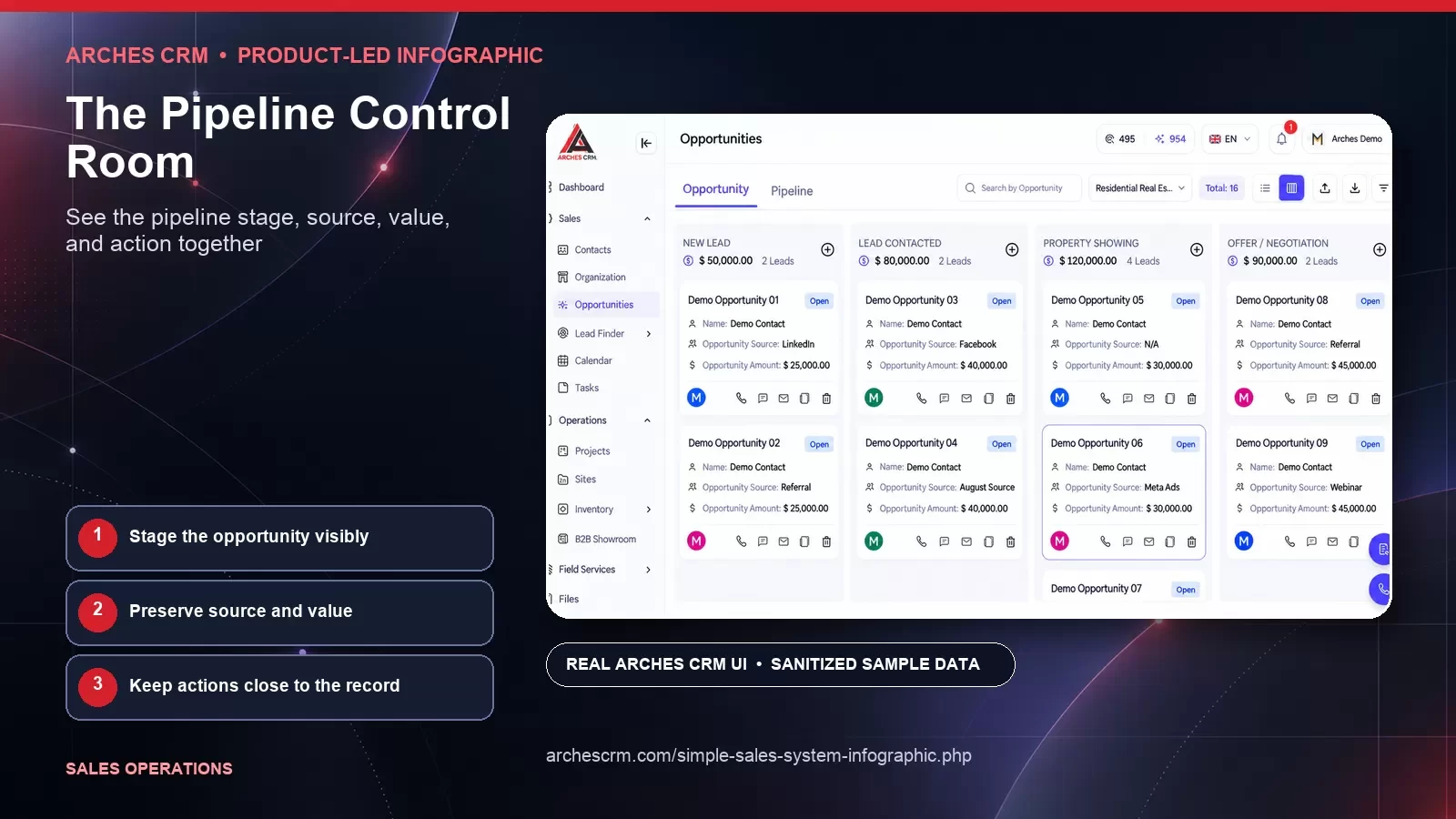
See the pipeline stage, source, value, and action together
Control stages from first capture through closed outcomes. These authentic Arches CRM application views use sanitized synthetic sample data and are specific to this workflow — not a repeated generic screenshot set.


Stage the opportunity visibly
Preserve source and value
Keep actions close to the record
Why this framework matters
A full pipeline can still be built on thin buyer evidence. Health depends on the quality of the evidence inside each opportunity: a real problem, an appropriate account, an identified decision path, and a next action accepted by the buyer. Totals alone cannot show whether those conditions exist.
Weak stage definitions encourage hopeful forecasting and hide stalled work. When representatives advance deals for activity rather than buyer evidence, coaching starts too late and forecasts become debates about confidence. A health diagnostic gives managers a consistent way to inspect the record without replacing judgment with a score.
The operating sequence keeps each sales handoff visible and accountable
Swipe or scroll to view the full diagram.
Read the infographic transcript
- CAPTURE: Create the record from a traceable source and preserve the person's stated context, permission, and request. Do not promote raw activity into an opportunity.
- ENRICH: Add only relevant, governed business context. Keep verified, inferred, unknown, and disputed values distinct so users can judge confidence.
- CONNECT: Make a relevant introduction that explains why contact is appropriate. Record the response, preference, and any reason the timing is wrong.
- MEET: Use the conversation to clarify the problem, impact, stakeholders, constraints, and decision. Preserve important unknowns and no-fit evidence.
- PROPOSE: Tie scope, assumptions, responsibilities, limitations, and evaluation evidence to the buyer's defined need. Avoid unsupported outcome promises.
- FOLLOW UP: Complete the agreed action in the expected window and adapt to the buyer's response. Internal reminders do not substitute for a mutual next step.
- CLOSE: Record the decision, terms, rationale, and unresolved handoff items whether the outcome is won, lost, paused, or no decision.
- GROW: Carry promises into delivery, review value with the customer, recover friction, and identify a relevant renewal or expansion only when evidence supports it.
Work through the framework
CAPTURE
Create the record from a traceable source and preserve the person's stated context, permission, and request. Do not promote raw activity into an opportunity.
ENRICH
Add only relevant, governed business context. Keep verified, inferred, unknown, and disputed values distinct so users can judge confidence.
CONNECT
Make a relevant introduction that explains why contact is appropriate. Record the response, preference, and any reason the timing is wrong.
MEET
Use the conversation to clarify the problem, impact, stakeholders, constraints, and decision. Preserve important unknowns and no-fit evidence.
PROPOSE
Tie scope, assumptions, responsibilities, limitations, and evaluation evidence to the buyer's defined need. Avoid unsupported outcome promises.
FOLLOW UP
Complete the agreed action in the expected window and adapt to the buyer's response. Internal reminders do not substitute for a mutual next step.
CLOSE
Record the decision, terms, rationale, and unresolved handoff items whether the outcome is won, lost, paused, or no decision.
GROW
Carry promises into delivery, review value with the customer, recover friction, and identify a relevant renewal or expansion only when evidence supports it.
How to apply it
Choose a small sample from each pipeline stage and review the six checks using only evidence visible in the record. If reviewers reach different conclusions, improve the stage entry and exit language before adding more fields or automation.
Use the diagnostic in coaching, not as a punishment mechanism. Ask what is known, what remains unknown, and which next action would resolve the uncertainty. Close or return opportunities when the evidence no longer supports the current stage, while preserving the reason for future learning.
When work stalls, diagnose the actual constraint before adding activity: buyer evidence, decision access, content, data quality, process ownership, team capacity, or a technical dependency. Choose one action that can resolve that constraint and record what the team learned.
What to review in your own process
Use first-party evidence from your own workflow. Define each measure before collection, preserve unknowns, and review quality with the teams responsible for the handoff.
- Opportunities with a buyer-acknowledged next action
- Stage changes supported by defined entry evidence
- Age and unresolved risk reviewed within the team's cadence
- Closed outcomes carrying a specific, reusable reason
Common questions
What makes a sales pipeline healthy?
A healthy pipeline contains opportunities with appropriate fit, current buyer evidence, clear ownership, realistic timing, and an agreed next action. The right volume depends on the business, so evaluate quality and movement alongside value.
How often should pipeline health be reviewed?
Use a cadence that matches the length and risk of your sales cycle. Review fast-moving opportunities more frequently, but make the inspection criteria consistent so the meeting is about decisions rather than status narration.
Is a pipeline health score enough for forecasting?
No. A score can organize attention, but it can hide uncertainty if users do not inspect the underlying evidence. Forecasting should retain human review, explicit assumptions, and a record of buyer-confirmed actions.
Primary references and review record
Editorial framework: This is an Arches CRM editorial framework. Its citations support related implementation, regulatory, measurement, privacy, accessibility, provider, or claim guidance; they do not independently validate the framework or prove a particular result.
- Google for Developers: GA4 recommended event: generate_lead (accessed 2026-09-27)
Author: Arches CRM Editorial Team · Reviewer: Arches CRM Revenue Operations Review · Last reviewed: 2026-09-27
Continue exploring
Related Arches CRM whitepapers
Put the framework into a real CRM workflow
Use your own records, definitions, and review process to evaluate whether Arches CRM fits the way your team works.
Start your 7-day trial