
 Log in
 Start Free Trial
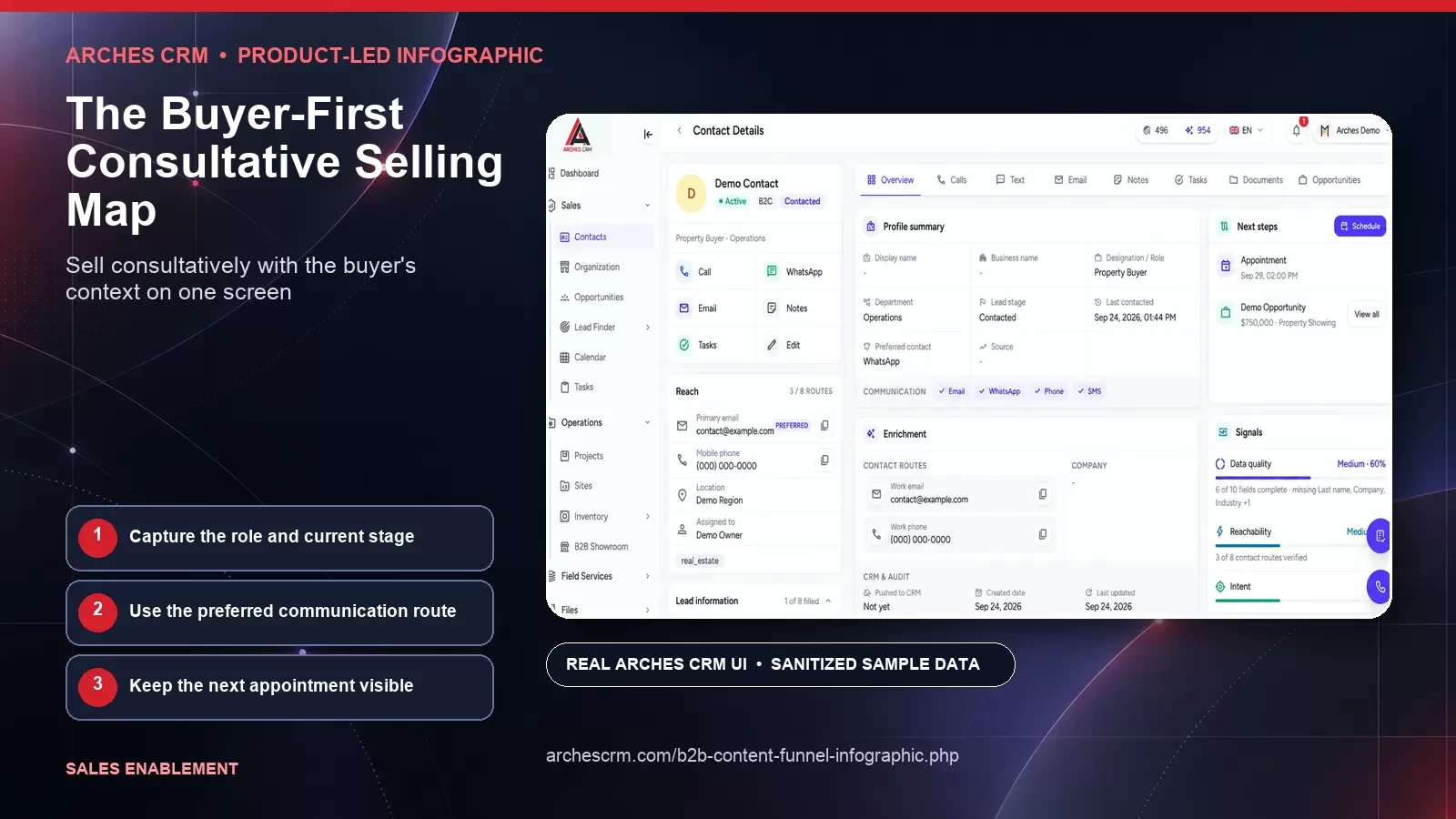
Sell consultatively with the buyer's context on one screen
Move content-engaged contacts into guided next steps. These authentic Arches CRM application views use sanitized synthetic sample data and are specific to this workflow — not a repeated generic screenshot set.


Capture the role and current stage
Use the preferred communication route
Keep the next appointment visible
Why this framework matters
Consultative selling does not mean avoiding a commercial conversation. It means delaying the recommendation until the problem, consequence, stakeholders, constraints, and desired evidence are understood well enough to test fit. The seller's job is to improve the quality of the decision, including when the offer is not appropriate.
Premature pitching forces the buyer to translate generic features into their own context. It also encourages sellers to ignore disconfirming evidence. A diagnosis map creates room for specific questions, transparent gaps, and a recommendation tied to the buyer's actual decision rather than a memorized product tour.
Teaching content answers the buyer's next question before asking for a sale
Swipe or scroll to view the full diagram.
Read the infographic transcript
- Answer the problem question: Help the buyer understand the situation, consequence, and alternatives in plain language. Define terms and avoid forcing the offer into the first paragraph.
- Answer the solution question: Explain the available approaches, tradeoffs, boundaries, and fit criteria. Let the reader compare paths before positioning a specific recommendation.
- Answer the proof question: Support material claims with attributable evidence, context, and limitations. Distinguish an illustration from a typical or guaranteed outcome.
- Answer the implementation question: Describe owners, inputs, dependencies, change, and likely obstacles. Show where validation is still required instead of hiding delivery work.
- Answer the decision question: Offer a next step proportional to intent: learn, compare, investigate, contact, try, pause, or stop. Explain what happens after the action.
Work through the framework
Answer the problem question
Help the buyer understand the situation, consequence, and alternatives in plain language. Define terms and avoid forcing the offer into the first paragraph.
Answer the solution question
Explain the available approaches, tradeoffs, boundaries, and fit criteria. Let the reader compare paths before positioning a specific recommendation.
Answer the proof question
Support material claims with attributable evidence, context, and limitations. Distinguish an illustration from a typical or guaranteed outcome.
Answer the implementation question
Describe owners, inputs, dependencies, change, and likely obstacles. Show where validation is still required instead of hiding delivery work.
Answer the decision question
Offer a next step proportional to intent: learn, compare, investigate, contact, try, pause, or stop. Explain what happens after the action.
How to apply it
Review recent calls and proposals for the point where a recommendation first appeared. Compare it with the evidence available at that moment. Build a small question set around decisions, consequences, constraints, and evaluation, then coach representatives to follow the buyer's answer rather than recite the list.
Update CRM notes and stages so they capture decisions and evidence instead of rewarding activity alone. Require sellers to name important unknowns and disqualifying information. That makes a thoughtful no-fit decision visible as useful work, not as missing data.
What to review in your own process
Use first-party evidence from your own workflow. Define each measure before collection, preserve unknowns, and review quality with the teams responsible for the handoff.
- Recommendations linked to a documented problem and constraint set
- Important unknowns recorded before a proposal or trial
- Mutual next actions accepted rather than assigned internally
- No-fit decisions captured early with a clear reason
Common questions
What is consultative selling?
Consultative selling is a decision-focused process in which the seller understands the buyer's problem, impact, constraints, stakeholders, and evaluation needs before recommending a solution.
How is consultative selling different from product pitching?
A pitch begins with the seller's offer. A consultative conversation begins with the buyer's decision and uses product information only where it helps evaluate fit. The seller also makes limits and no-fit conditions clear.
Which discovery questions are most useful?
Useful questions reveal the decision, current process, consequence, evidence, stakeholders, constraints, alternatives, timing, and next step. Their value comes from listening and follow-up, not from asking a fixed quantity.
Primary references and review record
Editorial framework: This is an Arches CRM editorial framework. Its citations support related implementation, regulatory, measurement, privacy, accessibility, provider, or claim guidance; they do not independently validate the framework or prove a particular result.
- Google Search Central: Creating helpful, reliable, people-first content (accessed 2026-09-27)
- Federal Trade Commission: Advertising FAQs: A Guide for Small Business (accessed 2026-09-27)
Author: Arches CRM Editorial Team · Reviewer: Arches CRM Revenue Operations Review · Last reviewed: 2026-09-27
Continue exploring
Related Arches CRM whitepapers
Put the framework into a real CRM workflow
Use your own records, definitions, and review process to evaluate whether Arches CRM fits the way your team works.
Start your 7-day trial