
 Log in
 Start Free Trial
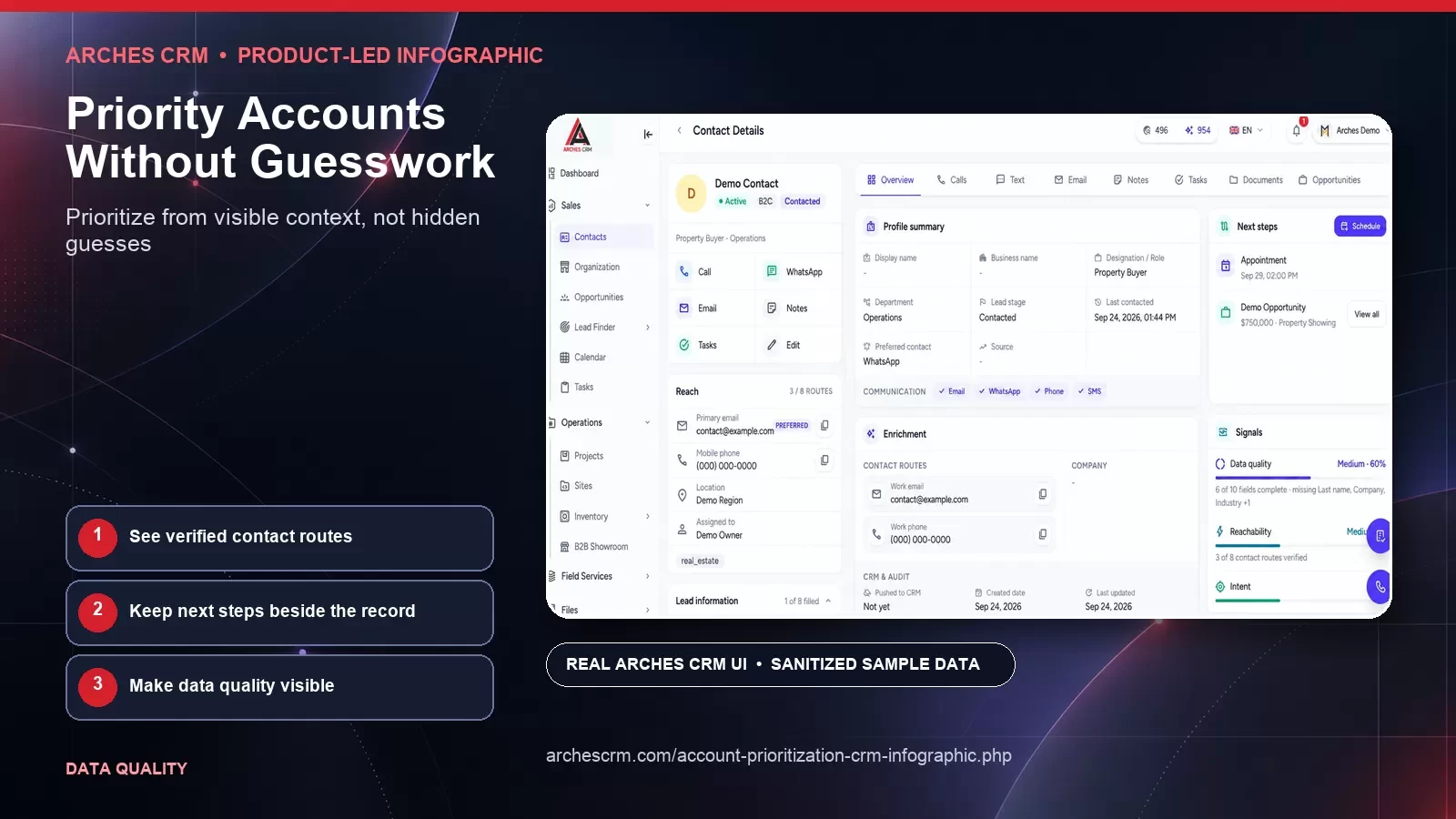
Prioritize from visible context, not hidden guesses
Score accounts from contact context into pipeline priority. These authentic Arches CRM application views use sanitized synthetic sample data and are specific to this workflow — not a repeated generic screenshot set.


See verified contact routes
Keep next steps beside the record
Make data quality visible
Why this framework matters
Valuable account intelligence is not a pile of personal details. It is a governed set of business-relevant signals collected for a defined purpose. The strongest model begins with why the data is needed, which team may use it, how the signal was obtained, and what action it can responsibly support.
When teams combine purchased, inferred, and first-party information without labels, confidence erodes. Sellers cannot distinguish a verified request from a weak guess, while privacy and compliance reviewers cannot trace origin or purpose. A permission-first map makes uncertainty visible and prevents sensitive or stale details from becoming automatic outreach triggers.
Account priority rests on transparent fit and current engagement evidence
Swipe or scroll to view the full diagram.
Read the infographic transcript
- Transparent account fit: Prioritize the organization against published business criteria such as use case, scope, and serviceability. Do not use wealth or unrelated personal characteristics as a shortcut.
- Relevant stakeholders: Identify confirmed roles involved in the business decision and preserve unknowns. Avoid treating inferred seniority or a job title as proof of authority.
- Permissioned engagement: Use declared interests and permitted interactions as context. Label inference clearly and never turn passive activity into a hidden certainty about buying intent.
- Accountable ownership: Assign one team to maintain the priority reason, coordinate contact, correct data, and prevent conflicting outreach across channels.
- Evidence-based next action: Choose the next action from current fit, stakeholder context, permission, and expressed need. Reassess priority when the evidence changes or the purpose ends.
Work through the framework
Transparent account fit
Prioritize the organization against published business criteria such as use case, scope, and serviceability. Do not use wealth or unrelated personal characteristics as a shortcut.
Relevant stakeholders
Identify confirmed roles involved in the business decision and preserve unknowns. Avoid treating inferred seniority or a job title as proof of authority.
Permissioned engagement
Use declared interests and permitted interactions as context. Label inference clearly and never turn passive activity into a hidden certainty about buying intent.
Accountable ownership
Assign one team to maintain the priority reason, coordinate contact, correct data, and prevent conflicting outreach across channels.
Evidence-based next action
Choose the next action from current fit, stakeholder context, permission, and expressed need. Reassess priority when the evidence changes or the purpose ends.
How to apply it
Inventory the fields currently used for targeting and group them by purpose, source, confidence, permission, owner, and review date. Pause any field that lacks a defensible use. This exercise usually reveals that fewer well-governed signals are more actionable than a large opaque profile.
Configure the CRM vocabulary before importing more records. Make verified, inferred, and unknown explicit values; do not use a blank field to represent all three. Limit access to sensitive context and document the criteria that permit a record to enter an outreach workflow.
Require a seller to explain every priority using current business evidence visible in the record. If the signal is inferred, expired, unrelated to the decision, or impossible to explain responsibly, remove it from the ranking rather than hiding it inside a score.
What to review in your own process
Use first-party evidence from your own workflow. Define each measure before collection, preserve unknowns, and review quality with the teams responsible for the handoff.
- Records with a documented source and business purpose
- Important signals carrying a verification or confidence status
- Suppression and correction requests completed through the agreed process
- Fields reviewed, revalidated, or retired by their policy date
Common questions
What is high-intent account data?
It is business-relevant evidence that an account may be evaluating a problem or solution, such as a direct request, a documented conversation, or an observable company event. It should not be confused with unrelated personal or demographic information.
Can inferred data be stored in a CRM?
Policies and laws vary, so obtain qualified guidance for your circumstances. Operationally, label inference clearly, preserve its source and confidence, restrict its use, and never present it to users as a verified fact.
How does data governance improve lead generation?
Governance improves the quality and explainability of targeting. Teams can focus on current, relevant, permitted signals and avoid wasting outreach on records that are stale, ambiguous, or unsuitable for the chosen channel.
Primary references and review record
Editorial framework: This is an Arches CRM editorial framework. Its citations support related implementation, regulatory, measurement, privacy, accessibility, provider, or claim guidance; they do not independently validate the framework or prove a particular result.
- National Institute of Standards and Technology: NIST Privacy Framework (accessed 2026-09-27)
- Information Commissioner's Office: Business-to-business marketing (accessed 2026-09-27)
Author: Arches CRM Editorial Team · Reviewer: Arches CRM Revenue Operations Review · Last reviewed: 2026-09-27
Continue exploring
Related Arches CRM whitepapers
Put the framework into a real CRM workflow
Use your own records, definitions, and review process to evaluate whether Arches CRM fits the way your team works.
Start your 7-day trial