
 Log in
 Start Free Trial
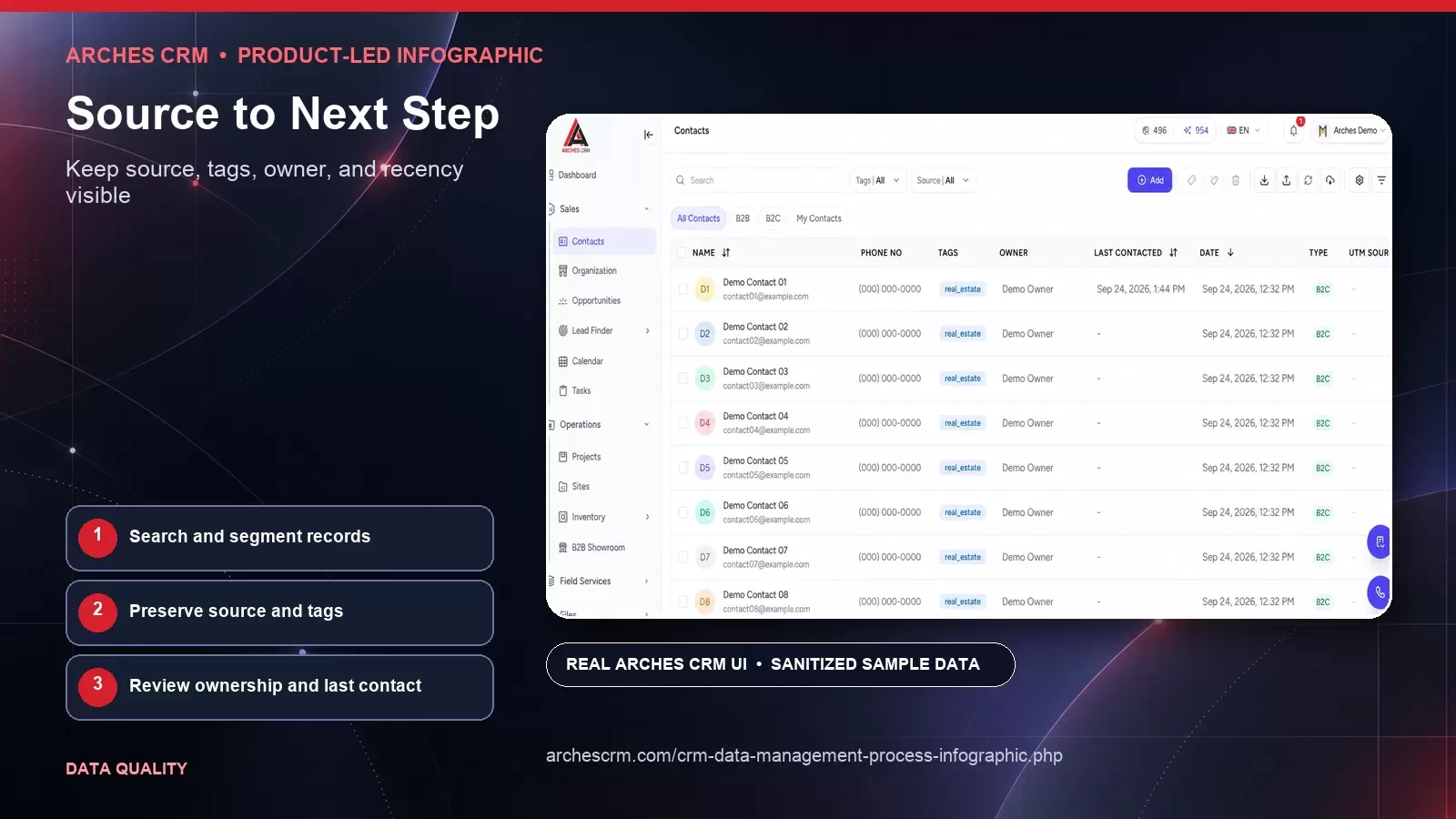
Keep source, tags, owner, and recency visible
Govern contact fields that feed pipeline quality. These authentic Arches CRM application views use sanitized synthetic sample data and are specific to this workflow — not a repeated generic screenshot set.


Search and segment records
Preserve source and tags
Review ownership and last contact
Why this framework matters
A reliable CRM database is built through decisions, not bulk accumulation. Teams must define the purpose of each data element, collect it transparently, validate identity, control enrichment, and assign stewardship. The record should explain enough of its origin and status for a user to judge whether it is suitable for the next action.
Opaque data pipelines hide duplication, misidentification, outdated information, and permission gaps until activation. Once bad data enters routing, reporting, and outreach, correction becomes more expensive. A documented build process prevents defects at the source and makes review possible when circumstances change.
Governed data moves from a traceable source to a justified next step
Swipe or scroll to view the full diagram.
Read the infographic transcript
- Preserve provenance: Record where important data came from, when it was obtained, the collection context, and whether it is first-party, supplied, or inferred.
- Validate the record: Check identity, format, plausibility, recency, and cross-field consistency. Label verified, unknown, inferred, and disputed values distinctly.
- Normalize carefully: Standardize formats and allowed values without erasing meaningful distinctions. Preserve raw source context when transformation could change interpretation.
- Control duplicates: Match people and organizations cautiously using reliable identifiers. Queue ambiguity for review instead of forcing merges that lose history.
- Confirm permission: Connect intended use and channel to the relevant notice, preference, legal basis, policy, and suppression before activation.
- Assign ownership: Give active records, definitions, exceptions, corrections, access, and suppressions an accountable owner with a clear escalation path.
- Review the next step: Recheck source, confidence, purpose, freshness, and buyer context before using the record. Retire data when the purpose or policy no longer supports it.
Work through the framework
Preserve provenance
Record where important data came from, when it was obtained, the collection context, and whether it is first-party, supplied, or inferred.
Validate the record
Check identity, format, plausibility, recency, and cross-field consistency. Label verified, unknown, inferred, and disputed values distinctly.
Normalize carefully
Standardize formats and allowed values without erasing meaningful distinctions. Preserve raw source context when transformation could change interpretation.
Control duplicates
Match people and organizations cautiously using reliable identifiers. Queue ambiguity for review instead of forcing merges that lose history.
Confirm permission
Connect intended use and channel to the relevant notice, preference, legal basis, policy, and suppression before activation.
Assign ownership
Give active records, definitions, exceptions, corrections, access, and suppressions an accountable owner with a clear escalation path.
Review the next step
Recheck source, confidence, purpose, freshness, and buyer context before using the record. Retire data when the purpose or policy no longer supports it.
How to apply it
Create a field dictionary for one workflow. For each field, record its purpose, source, allowed values, validation rule, owner, access, retention, and downstream consumers. Remove hidden dependencies before changing the schema or import process.
Test the build process with controlled fixtures that include duplicates, missing permission, ambiguous identities, stale information, and opt-outs. Require each exception to fail safely. Then sample production records and compare their lineage with the documented rules.
Treat data as a lifecycle rather than an import: define its purpose, capture and verify it, control access, assign stewardship, propagate corrections, review retention, and document every downstream use. A field without an owner or permitted purpose should not silently persist.
What to review in your own process
Use first-party evidence from your own workflow. Define each measure before collection, preserve unknowns, and review quality with the teams responsible for the handoff.
- Workflow fields with documented purpose, source, and owner
- Ambiguous identities held for review rather than force-matched
- Enriched values carrying provider, date, confidence, and use limits
- Corrections and suppressions propagated to every downstream consumer
Common questions
What is a CRM data build process?
It is the governed sequence used to define, collect, match, validate, enrich, store, review, correct, and retire CRM data. The process should make source, status, ownership, and permitted use understandable.
Should enrichment happen before data validation?
Validate core identity and source first. Enriching an incorrect or ambiguous match can make the record appear more complete while increasing the cost and risk of correction.
How can teams prevent duplicate CRM records?
Use reliable identifiers, normalization, match rules, exception queues, and human review for ambiguity. Prevent duplicates at capture and integration boundaries rather than relying only on periodic cleanup.
Primary references and review record
Editorial framework: This is an Arches CRM editorial framework. Its citations support related implementation, regulatory, measurement, privacy, accessibility, provider, or claim guidance; they do not independently validate the framework or prove a particular result.
- National Institute of Standards and Technology: NIST Privacy Framework (accessed 2026-09-27)
- Information Commissioner's Office: Business-to-business marketing (accessed 2026-09-27)
Author: Arches CRM Editorial Team · Reviewer: Arches CRM Revenue Operations Review · Last reviewed: 2026-09-27
Continue exploring
Related Arches CRM whitepapers
Put the framework into a real CRM workflow
Use your own records, definitions, and review process to evaluate whether Arches CRM fits the way your team works.
Start your 7-day trial