
 Log in
 Start Free Trial
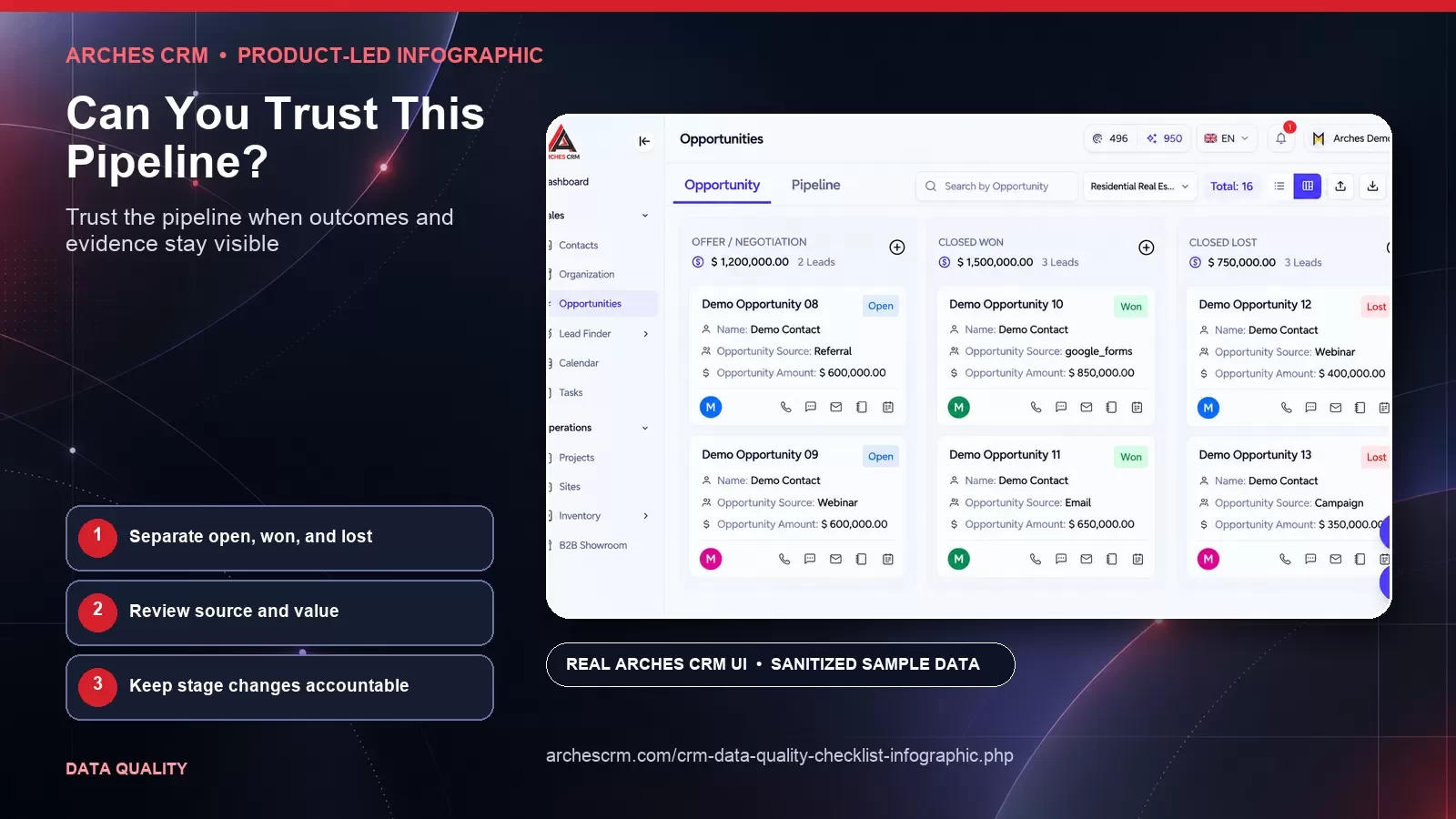
Trust the pipeline when outcomes and evidence stay visible
Audit late-stage records against clean contact fields. These authentic Arches CRM application views use sanitized synthetic sample data and are specific to this workflow — not a repeated generic screenshot set.


Separate open, won, and lost
Review source and value
Keep stage changes accountable
Why this framework matters
Database health is not the percentage of fields filled. A record can be complete and still be wrong, stale, duplicated, unsuitable for the intended channel, or detached from an accountable owner. Health should be evaluated in relation to the decision or workflow the data is expected to support.
Poor data quality multiplies downstream. It can misroute a lead, distort a forecast, send irrelevant messages, create duplicate work, and weaken confidence in reporting. A compact health check helps teams find the highest-risk gaps before launching automation or drawing conclusions from the database.
Pipeline trust depends on data integrity and a current, accountable next step
Swipe or scroll to view the full diagram.
Read the infographic transcript
- Traceable source: Preserve where the record and key information came from, when it was obtained, and whether it is first-party, supplied, or inferred.
- Duplicate control: Detect possible duplicates without blindly merging distinct people, business units, opportunities, or histories. Route ambiguous matches for review.
- Permission fitness: Verify that the intended use and channel align with the person's choices, applicable rules, and internal policy. Keep suppression authoritative.
- Valid contact context: Confirm the person, company, role, and available contact method are current enough for the intended action. Label unknowns rather than inventing values.
- Accountable owner: Give every active opportunity and quality exception a responsible owner. Make reassignment rules clear when roles or territories change.
- Buyer-backed next action: Use an action the buyer requested or accepted. An internal follow-up date alone does not demonstrate momentum or justify the current stage.
- Stage age in context: Review how long the record has remained without new evidence in relation to the real buying process. Do not use a universal aging cutoff.
- Specific close reason: Record why work was won, lost, paused, disqualified, or ended without a decision. Use precise reasons to improve qualification and handoffs.
Work through the framework
Traceable source
Preserve where the record and key information came from, when it was obtained, and whether it is first-party, supplied, or inferred.
Duplicate control
Detect possible duplicates without blindly merging distinct people, business units, opportunities, or histories. Route ambiguous matches for review.
Permission fitness
Verify that the intended use and channel align with the person's choices, applicable rules, and internal policy. Keep suppression authoritative.
Valid contact context
Confirm the person, company, role, and available contact method are current enough for the intended action. Label unknowns rather than inventing values.
Accountable owner
Give every active opportunity and quality exception a responsible owner. Make reassignment rules clear when roles or territories change.
Buyer-backed next action
Use an action the buyer requested or accepted. An internal follow-up date alone does not demonstrate momentum or justify the current stage.
Stage age in context
Review how long the record has remained without new evidence in relation to the real buying process. Do not use a universal aging cutoff.
Specific close reason
Record why work was won, lost, paused, disqualified, or ended without a decision. Use precise reasons to improve qualification and handoffs.
How to apply it
Select one important workflow—such as inbound lead routing—and trace the minimum data it needs from capture to outcome. Sample records at each handoff, record the type and consequence of defects, and fix the source rule before performing a broad cleanup.
Create explicit values for unknown, not applicable, inferred, and verified where those distinctions matter. Assign owners to both records and data definitions. Re-run the same sample after the fix so the team can confirm the process changed, not merely the current spreadsheet.
What to review in your own process
Use first-party evidence from your own workflow. Define each measure before collection, preserve unknowns, and review quality with the teams responsible for the handoff.
- Workflow-critical fields carrying a valid source and status
- Duplicate and mismatch exceptions resolved without losing history
- Active records with an accountable owner and review trigger
- Errors prevented at capture rather than corrected after activation
Common questions
What is CRM data health?
CRM data is healthy when it is sufficiently accurate, traceable, permitted, complete, owned, and current for a defined business use. Health is contextual; a record suitable for one purpose may be unsuitable for another.
Should every CRM field be mandatory?
No. Make a field required only when the next decision truly depends on it and users can reasonably know the answer. Excessive mandatory fields encourage placeholders, delay work, and can reduce data quality.
Where should a CRM cleanup begin?
Begin with a high-value workflow and the defects that create the greatest operational, customer, or compliance risk. Repair the capture and governance rules before attempting a one-time database-wide cleanup.
Primary references and review record
Editorial framework: This is an Arches CRM editorial framework. Its citations support related implementation, regulatory, measurement, privacy, accessibility, provider, or claim guidance; they do not independently validate the framework or prove a particular result.
- National Institute of Standards and Technology: NIST Privacy Framework (accessed 2026-09-27)
- Information Commissioner's Office: Business-to-business marketing (accessed 2026-09-27)
Author: Arches CRM Editorial Team · Reviewer: Arches CRM Revenue Operations Review · Last reviewed: 2026-09-27
Continue exploring
Related Arches CRM whitepapers
Put the framework into a real CRM workflow
Use your own records, definitions, and review process to evaluate whether Arches CRM fits the way your team works.
Start your 7-day trial