
 Log in
 Start Free Trial
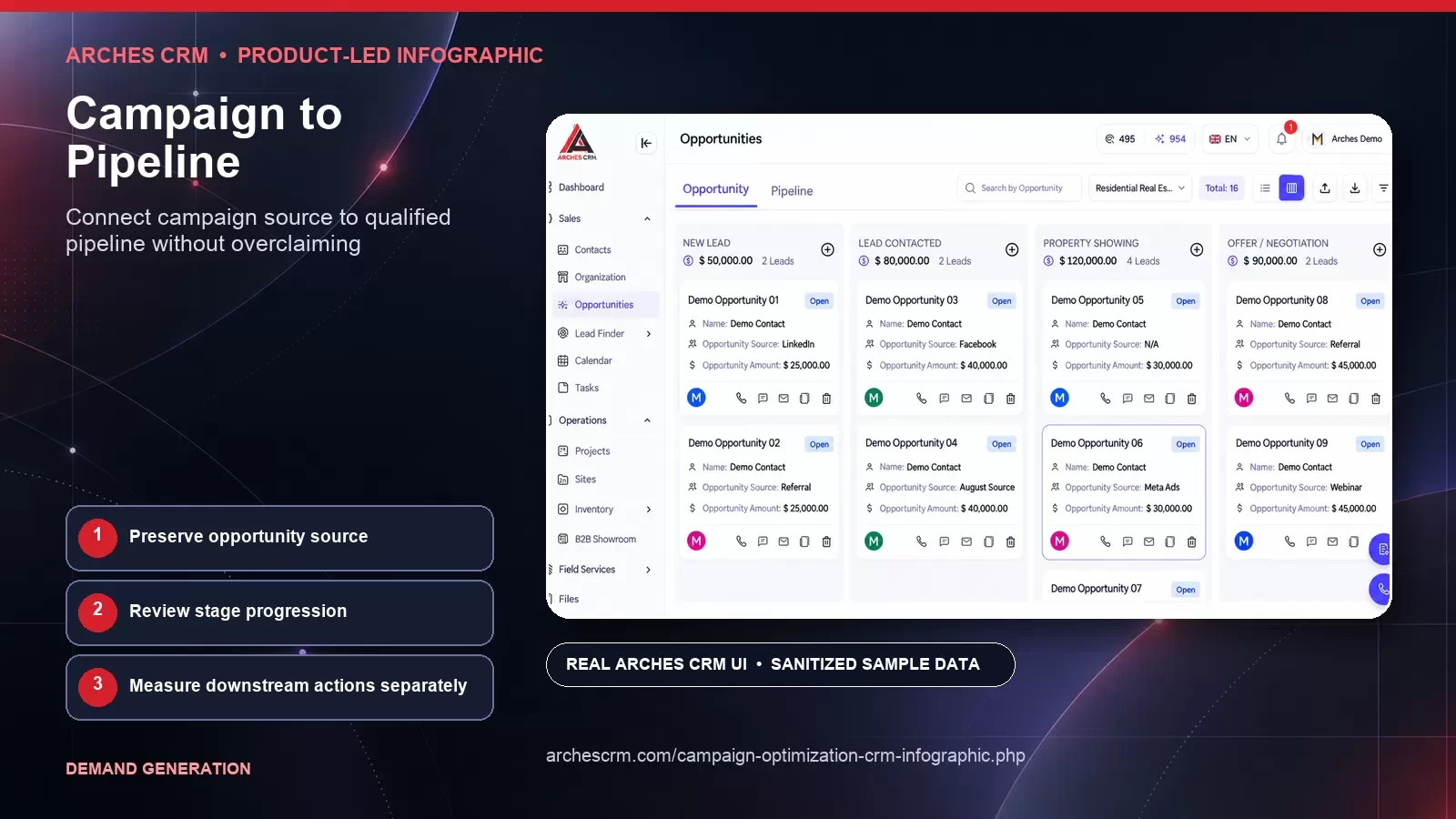
Connect campaign source to qualified pipeline without overclaiming
Connect campaign-sourced opportunities to stage health. These authentic Arches CRM application views use sanitized synthetic sample data and are specific to this workflow — not a repeated generic screenshot set.


Preserve opportunity source
Review stage progression
Measure downstream actions separately
Why this framework matters
Optimization is a decision process, not a sequence of constant edits. Teams need a stable objective, a trustworthy baseline, and a clear reason for changing one part of the campaign. Without those controls, a temporary movement in clicks or replies can prompt a change that harms qualified outcomes.
Campaign data becomes difficult to interpret when audience, message, offer, channel, timing, and routing change together. A control loop protects learning by isolating the decision, monitoring for harm, and carrying the result into the next test. It also makes failure useful rather than something to hide.
Campaign learning runs from a testable hypothesis to a qualified outcome
Swipe or scroll to view the full diagram.
Read the infographic transcript
- Testable hypothesis: Name the expected audience behavior or business outcome, why the proposed change may influence it, and how the result will guide a decision.
- Defined audience: Document fit, exclusions, permission, source, and known gaps before activation so a changing audience does not disguise the campaign result.
- Relevant message: Connect the business problem, useful answer, proof, and offer to the audience context. Keep claim scope and limitations visible.
- Meaningful action: Choose an action that represents the campaign's real purpose, such as a direct request or evaluation step, rather than optimizing an easy proxy alone.
- Contextual routing: Move each response to nurture, human follow-up, service, suppression, or another defined path with an accountable owner and preserved context.
- Completed follow-up: Deliver the promised next action and record the response. A campaign cannot be judged fairly if the handoff fails after conversion.
- Qualified outcome: Evaluate fit, problem, timing, decision, and buyer-accepted progression. Keep lead creation distinct from an opportunity or won result.
- Learning loop: Record what changed, what happened, confidence, limitations, and the next question. Reverse weak changes and standardize useful ones carefully.
Work through the framework
Testable hypothesis
Name the expected audience behavior or business outcome, why the proposed change may influence it, and how the result will guide a decision.
Defined audience
Document fit, exclusions, permission, source, and known gaps before activation so a changing audience does not disguise the campaign result.
Relevant message
Connect the business problem, useful answer, proof, and offer to the audience context. Keep claim scope and limitations visible.
Meaningful action
Choose an action that represents the campaign's real purpose, such as a direct request or evaluation step, rather than optimizing an easy proxy alone.
Contextual routing
Move each response to nurture, human follow-up, service, suppression, or another defined path with an accountable owner and preserved context.
Completed follow-up
Deliver the promised next action and record the response. A campaign cannot be judged fairly if the handoff fails after conversion.
Qualified outcome
Evaluate fit, problem, timing, decision, and buyer-accepted progression. Keep lead creation distinct from an opportunity or won result.
Learning loop
Record what changed, what happened, confidence, limitations, and the next question. Reverse weak changes and standardize useful ones carefully.
How to apply it
Create a one-page experiment brief before editing the campaign. It should name the decision, audience, hypothesis, single primary change, guardrails, observation window, owner, and interpretation rule. Require the brief to link to the resulting CRM or analytics evidence.
Hold a short readout that includes marketing, sales, and the owner of any affected handoff. Compare lead quality and next actions with the baseline, document external factors, and decide whether to keep, reverse, or run a clarifying test. Do not promote a result as universal.
Before optimizing the nearest visible metric, identify the business bottleneck and the qualified outcome that would prove progress. Use a controlled change, preserve the baseline, and keep the learning record even when the test fails.
What to review in your own process
Use first-party evidence from your own workflow. Define each measure before collection, preserve unknowns, and review quality with the teams responsible for the handoff.
- Tests with a prewritten decision and interpretation rule
- Qualified progression reviewed alongside channel activity
- Guardrail issues found before a broader rollout
- Completed experiments with a reusable learning record
Common questions
What is a campaign optimization framework?
It is a repeatable way to define a campaign decision, establish a baseline, diagnose a constraint, test a bounded change, inspect downstream effects, and retain what the team learned.
Which campaign metric should be optimized first?
Start with the constraint closest to the desired business decision, while protecting customer and operational guardrails. The right metric depends on the campaign purpose and the quality of the data available.
Why should campaign changes be limited?
Limiting a test makes interpretation more credible. When many elements change together, teams cannot tell which change mattered or whether an outside event created the observed result.
Primary references and review record
Editorial framework: This is an Arches CRM editorial framework. Its citations support related implementation, regulatory, measurement, privacy, accessibility, provider, or claim guidance; they do not independently validate the framework or prove a particular result.
- Google Analytics: Campaigns and traffic sources (accessed 2026-09-27)
- Google for Developers: GA4 recommended event: generate_lead (accessed 2026-09-27)
Author: Arches CRM Editorial Team · Reviewer: Arches CRM Revenue Operations Review · Last reviewed: 2026-09-27
Continue exploring
Related Arches CRM whitepapers
Put the framework into a real CRM workflow
Use your own records, definitions, and review process to evaluate whether Arches CRM fits the way your team works.
Start your 7-day trial