
 Log in
 Start Free Trial
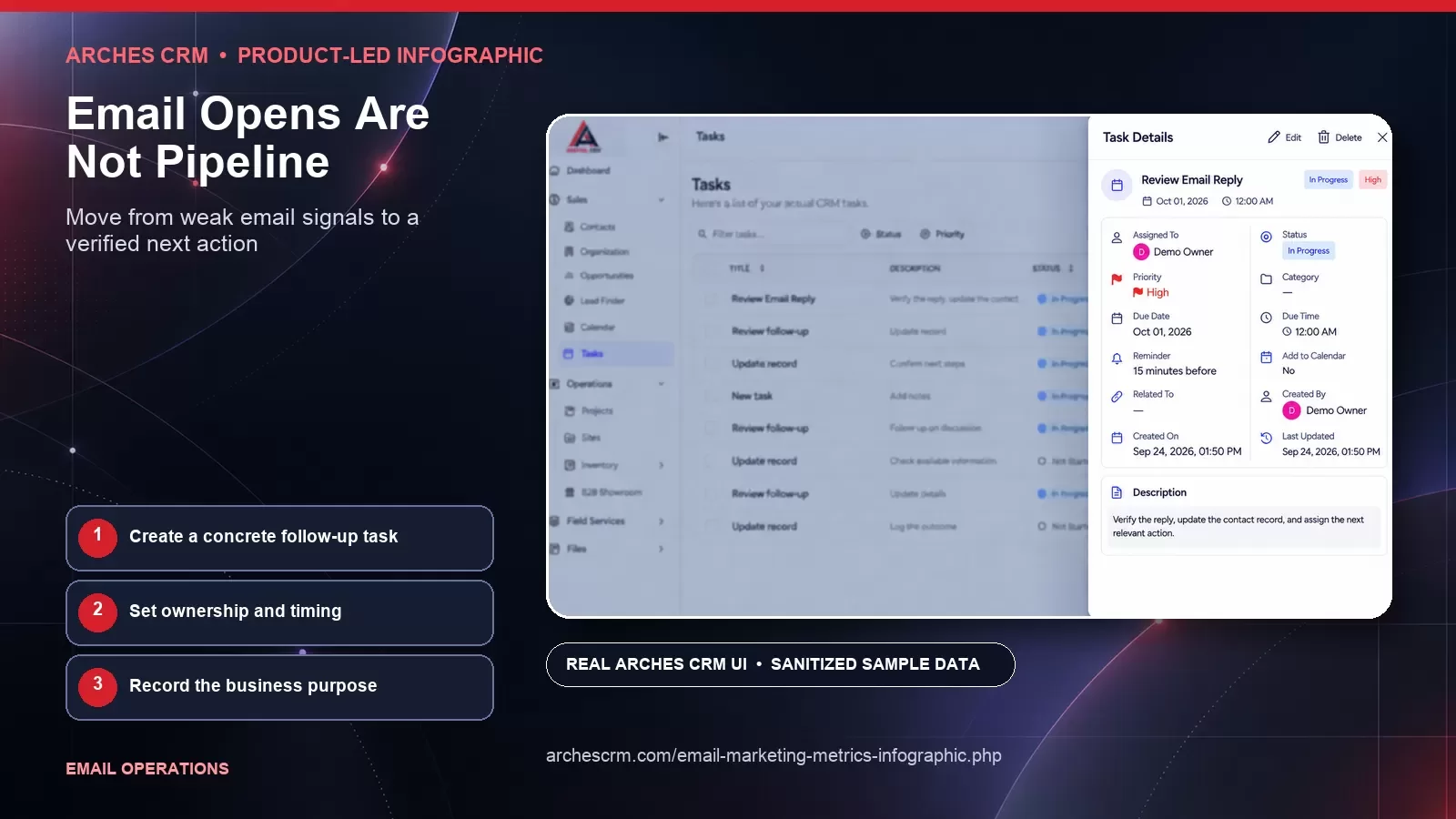
Move from weak email signals to a verified next action
Review email follow-up tasks against contact timing. These authentic Arches CRM application views use sanitized synthetic sample data and are specific to this workflow — not a repeated generic screenshot set.


Create a concrete follow-up task
Set ownership and timing
Record the business purpose
Why this framework matters
An email open can be useful for technical and directional analysis, but privacy protections, automated image loading, and client behavior limit what it can prove. Campaign health should be inspected across delivery, sender recognition, message relevance, recipient action, qualification, and the eventual business decision.
Optimizing only for opens can reward sensational subject lines, obscure deliverability problems, and disconnect marketing from lead quality. A full-path diagnostic helps teams identify the actual constraint and choose a repair that protects trust rather than inflating the nearest visible metric.
Email signals become more meaningful as they approach a verified business decision
Swipe or scroll to view the full diagram.
Read the infographic transcript
- Delivery: Confirm whether the provider accepted the message and inspect authentication, suppression, list origin, and sending context before reading engagement.
- Bounce: Classify permanent and temporary failures according to current provider evidence, correct the source process, and prevent repeated sending to invalid destinations.
- Complaint: Treat a complaint as a strong negative signal about expectation, permission, identity, relevance, or frequency. Investigate and protect the recipient first.
- Click: Use a click as evidence that a link was activated, not proof of a qualified buyer. Account for scanners, accidental actions, and page context.
- Reply: Classify the person's direct response by request, objection, preference, support need, interest, or no-fit while preserving their actual context.
- Meeting: Separate a booked time from an attended, relevant conversation. Capture the business question, owner, and accepted next action.
- Qualified lead: Evaluate fit, problem, timing, permission, and a meaningful request under the team's published definition. Do not qualify from an open or click alone.
- Opportunity: Require buyer evidence for the defined sales stage, including decision context and a mutual next action. Preserve uncertainty and disqualifying facts.
- Win: Record the completed commercial decision and its source history while keeping other influences and attribution limits visible.
Work through the framework
Delivery
Confirm whether the provider accepted the message and inspect authentication, suppression, list origin, and sending context before reading engagement.
Bounce
Classify permanent and temporary failures according to current provider evidence, correct the source process, and prevent repeated sending to invalid destinations.
Complaint
Treat a complaint as a strong negative signal about expectation, permission, identity, relevance, or frequency. Investigate and protect the recipient first.
Click
Use a click as evidence that a link was activated, not proof of a qualified buyer. Account for scanners, accidental actions, and page context.
Reply
Classify the person's direct response by request, objection, preference, support need, interest, or no-fit while preserving their actual context.
Meeting
Separate a booked time from an attended, relevant conversation. Capture the business question, owner, and accepted next action.
Qualified lead
Evaluate fit, problem, timing, permission, and a meaningful request under the team's published definition. Do not qualify from an open or click alone.
Opportunity
Require buyer evidence for the defined sales stage, including decision context and a mutual next action. Preserve uncertainty and disqualifying facts.
Win
Record the completed commercial decision and its source history while keeping other influences and attribution limits visible.
How to apply it
Build a campaign review from the bottom of the path upward. Start with relevant replies, qualified actions, and disqualifications; then inspect the audience, message, delivery, and open or click signals that preceded them. This reduces the temptation to optimize a proxy in isolation.
Use open data cautiously and document known limitations in dashboards. Monitor complaints, negative replies, unsubscribes, and sales feedback as guardrails. If a subject line increases opens but worsens trust or lead quality, treat it as a failed change.
What to review in your own process
Use first-party evidence from your own workflow. Define each measure before collection, preserve unknowns, and review quality with the teams responsible for the handoff.
- Messages accepted without avoidable technical or suppression errors
- Replies and deliberate actions classified by relevance and intent
- Qualified next steps traced to the campaign without overstating attribution
- Negative signals reviewed as guardrails during optimization
Common questions
Are email open rates reliable?
Open data is incomplete and can be distorted by privacy features, image loading, bots, and client behavior. Use it as one directional signal, then inspect deliberate responses and downstream quality.
What is a healthy email campaign?
A healthy campaign reaches an appropriate, permitted audience with a recognizable and relevant message, produces useful recipient actions, protects trust, and contributes evidence for a defined business decision.
Which signals should be reviewed beyond opens?
Review delivery and bounce categories, complaints, unsubscribes, replies, preference changes, direct requests, qualified progression, handoff quality, and actual outcomes relevant to the campaign goal.
Primary references and review record
Editorial framework: This is an Arches CRM editorial framework. Its citations support related implementation, regulatory, measurement, privacy, accessibility, provider, or claim guidance; they do not independently validate the framework or prove a particular result.
- Apple: Use Mail Privacy Protection on iPhone (accessed 2026-09-27)
- Google for Developers: GA4 recommended event: generate_lead (accessed 2026-09-27)
Author: Arches CRM Editorial Team · Reviewer: Arches CRM Revenue Operations Review · Last reviewed: 2026-09-27
Continue exploring
Related Arches CRM whitepapers
Put the framework into a real CRM workflow
Use your own records, definitions, and review process to evaluate whether Arches CRM fits the way your team works.
Start your 7-day trial