
 Log in
 Start Free Trial
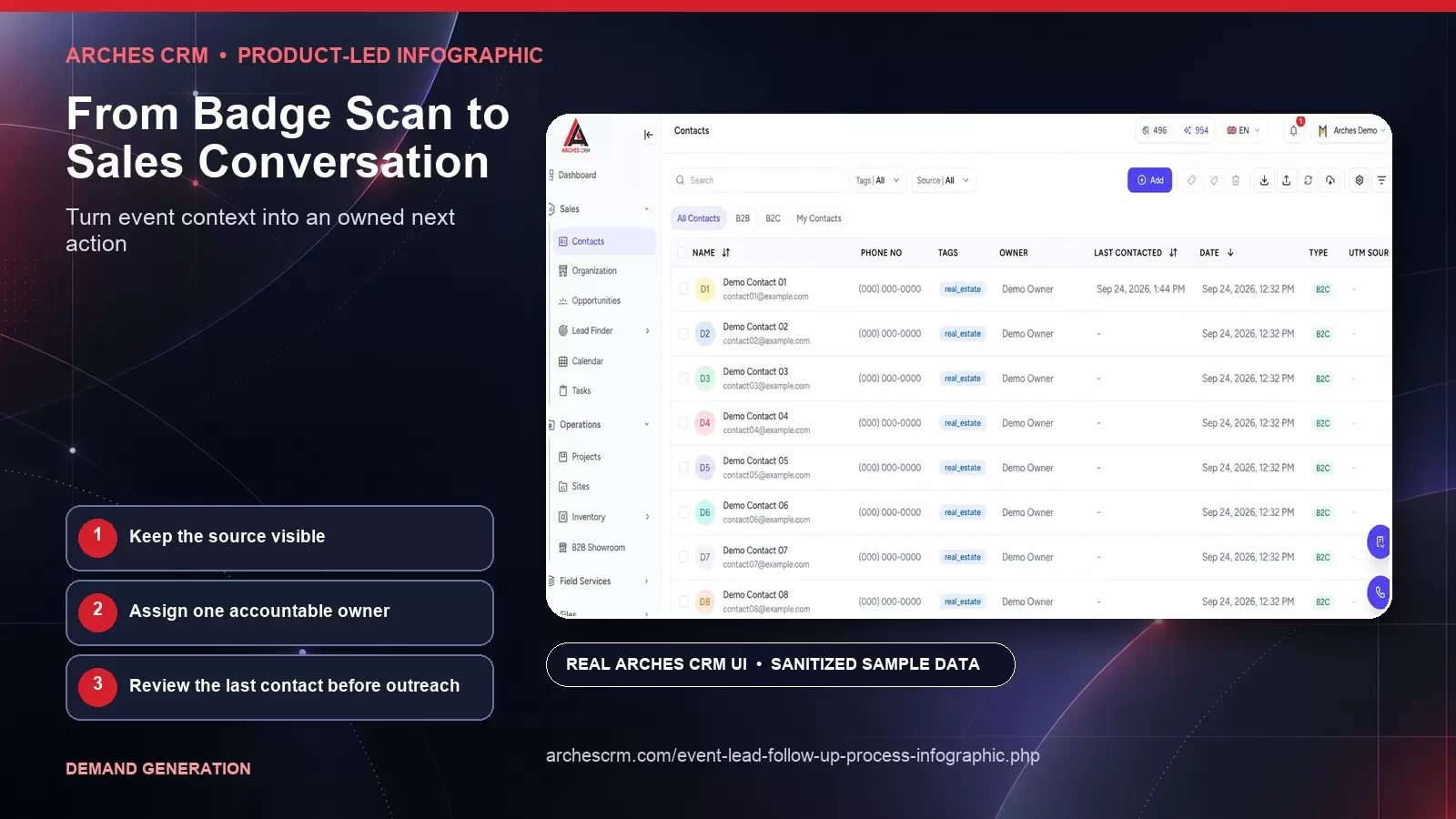
Turn event context into an owned next action
Capture the event source, then route the next owned action. These authentic Arches CRM application views use sanitized synthetic sample data and are specific to this workflow — not a repeated generic screenshot set.


Keep the source visible
Assign one accountable owner
Review the last contact before outreach
Why this framework matters
An event creates a temporary concentration of attention, but attention is not the same as buying intent. The useful work begins before registration opens: define the business question the event should answer, the audience signals that matter, and the next action each signal should trigger. This keeps teams from measuring success by booth traffic or a raw contact count alone.
The handoff between marketing and sales is where event context is often lost. A contact record without the conversation topic, permission status, timing, or owner gives a seller little reason to act. A disciplined event workflow preserves that context, distinguishes curiosity from active evaluation, and creates a learning record for the next event decision.
Event attention becomes pipeline evidence through controlled handoffs
Swipe or scroll to view the full diagram.
Read the infographic transcript
- Verify source and permission: Preserve the event source, explain how the record was obtained, and confirm the allowed follow-up channel. A badge scan should not silently become unlimited outreach permission.
- Capture conversation context: Record the business topic, the person's stated need, and the follow-up that was promised. Keep notes factual, proportionate, and useful to the next person.
- Assign an accountable owner: Give each accepted follow-up to one responsible person or team with a visible service expectation. Avoid shared queues that conceal whether anyone acted.
- Qualify from evidence: Separate fit, expressed problem, decision role, timing, and uncertainty. Attendance or a scan alone should never create a sales-ready stage.
- Agree the next action: Use an action the buyer requested or accepted, such as an answer, resource, discovery call, or evaluation. Preserve unanswered questions rather than inventing momentum.
- Attribute with limits: Connect source and downstream outcome while keeping other influences visible. Use the evidence to improve future events, not to claim that attendance alone caused revenue.
Work through the framework
Verify source and permission
Preserve the event source, explain how the record was obtained, and confirm the allowed follow-up channel. A badge scan should not silently become unlimited outreach permission.
Capture conversation context
Record the business topic, the person's stated need, and the follow-up that was promised. Keep notes factual, proportionate, and useful to the next person.
Assign an accountable owner
Give each accepted follow-up to one responsible person or team with a visible service expectation. Avoid shared queues that conceal whether anyone acted.
Qualify from evidence
Separate fit, expressed problem, decision role, timing, and uncertainty. Attendance or a scan alone should never create a sales-ready stage.
Agree the next action
Use an action the buyer requested or accepted, such as an answer, resource, discovery call, or evaluation. Preserve unanswered questions rather than inventing momentum.
Attribute with limits
Connect source and downstream outcome while keeping other influences visible. Use the evidence to improve future events, not to claim that attendance alone caused revenue.
How to apply it
Start with one event and one shared definition of a meaningful response. Agree on required context fields, ownership, and the point at which marketing hands a record to sales. Test the workflow with a small set of real conversations before expanding it across the event calendar.
In your CRM, keep the event source and the contact's current intent separate. That distinction lets the team compare follow-up quality without implying that attendance caused revenue. Review stalled records with marketing and sales together so the process improves at the handoff, not only inside one department.
What to review in your own process
Use first-party evidence from your own workflow. Define each measure before collection, preserve unknowns, and review quality with the teams responsible for the handoff.
- Share of captured conversations with an accountable next owner
- Time from a requested follow-up to the first relevant response
- Progression based on a verified meeting or evaluation action
- Reasons qualified contacts pause, decline, or return to nurture
Common questions
What should a B2B event marketing strategy measure?
Measure the chain from relevant audience engagement to a verified next action, then to qualified progression. Keep attendance, conversations, meetings, and pipeline outcomes separate so the team can see where context or follow-up is breaking.
Should every event attendee go directly to sales?
No. Route people according to fit, expressed intent, permission, and requested timing. Someone gathering general information may need useful education, while a buyer who asks for an evaluation deserves prompt human follow-up.
How can a CRM support event follow-up?
A CRM can serve as the shared record for source, conversation context, ownership, next action, and outcome when those fields and processes are configured intentionally. Verify the exact workflow in the platform you plan to use.
Primary references and review record
Editorial framework: This is an Arches CRM editorial framework. Its citations support related implementation, regulatory, measurement, privacy, accessibility, provider, or claim guidance; they do not independently validate the framework or prove a particular result.
- Google Analytics: Campaigns and traffic sources (accessed 2026-09-27)
- Google for Developers: GA4 recommended event: generate_lead (accessed 2026-09-27)
- Federal Trade Commission: CAN-SPAM Act: A Compliance Guide for Business (accessed 2026-09-27)
Author: Arches CRM Editorial Team · Reviewer: Arches CRM Revenue Operations Review · Last reviewed: 2026-09-27
Continue exploring
Related Arches CRM whitepapers
Put the framework into a real CRM workflow
Use your own records, definitions, and review process to evaluate whether Arches CRM fits the way your team works.
Start your 7-day trial